
For most Singaporeans, May Day shows up on the calendar as one thing: public holiday.
Maybe an extra day to sleep in, run errands, or squeeze in a quick getaway if it lines up nicely with a weekend…just like this year’s May Day.
But May Day actually has a backstory that goes way beyond “free day from work”, and it’s a backstory that quietly affects pretty much every working person in Singapore, whether you’re a fresh grad, a mid-career PME, or running your own business.
So What Is May Day Actually About?
May Day, or International Workers’ Day, is observed in many countries around the world as a day to recognise workers and the labour movement.
And here’s the interesting fact: In a lot of places, that recognition takes the form of marches, protests, or even strikes, sometimes peaceful, sometimes not so much.
Yup, Singapore’s version looks VERY different.
Instead of confrontation, our May Day is anchored by the annual May Day Rally, organised by the National Trades Union Congress (NTUC). It brings together union leaders, employers, and government officials in one place to do something genuinely unusual on a global scale: sit down together, take stock of what’s been done for workers, and agree on what comes next.
There are no clashes and no picket lines, just a roomful of people from very different sides of the table, all wearing red (i.e. that iconic NTUC polo tee) and all working towards the same outcome: better lives for workers.
This approach has a name.
It’s called tripartism, and if you’ve ever benefited from a wage increase, workplace protection, training subsidy, or fair employment practice in Singapore, tripartism probably had something to do with it.
So, what is tripartism?
What Exactly Is Tripartism?
In plain English, tripartism is the partnership between three groups: unions (NTUC), employers (represented by SNEF), and the Government (Ministry of Manpower).
In other countries, they are often arguing amongst each other: the unions want better rights for the workers, the employers want better bottom line by compromising workers’ rights, and the Government caught between the two of them.
But in tripartism, instead of arguing over the table, these three sides work together to shape the rules of work in Singapore.
They figure out wages, employment protections, training, and how to respond to crises (think SARS, the 2008 financial crisis, COVID-19), and increasingly, how to navigate newer disruptors like AI, which is rapidly reshaping what jobs look like across nearly every industry. The goal stays the same: workers and businesses both come out okay.
Because Singapore has such a strong tripartism, our employment landscape has remained relatively stable through decades of global turbulence.
The Misconceptions People Have About Tripartism
Because tripartism doesn’t exactly make for dramatic headlines or for any exciting TikTok content, a lot of Singaporeans either don’t know about it, or have some pretty off-base assumptions. Let’s clear a few up.
Misconception #1: “Tripartism is only for blue-collar workers and unions.”
Nope. Tripartism shapes policies that touch every worker, including PMEs.
From parental leave entitlements to flexible work arrangement guidelines to protection from workplace harassment, the frameworks that govern your office life were largely shaped through tripartite discussions.
A more recent example is the Workplace Fairness Act, Singapore’s first-ever anti-discrimination law covering things like age, gender, race, religion, and disability, which was developed through years of tripartite consultation between unions, employers and the Government before being passed in Parliament.
Misconception #2: “It’s just three groups talking. Does anything actually come out of it?”
Quite a lot, actually. Here are some things you’ve probably benefited from without realising tripartism was behind them:
- The Progressive Wage Model that’s pushed up wages for lower-wage workers
- Tripartite guidelines on fair employment and flexible work arrangements
- Protections against workplace harassment and age discrimination
- Re-employment of older workers (so people aged 63+ can keep working if they want to)
- Crisis response during COVID-19, including the Self-Employed Person Income Relief Scheme (SIRS), where NTUC and its Freelancers and Self-Employed Unit (U FSE) helped administer applications and appeals to get cash relief into the hands of self-employed Singaporeans whose incomes were disrupted by the pandemic
- Recent relief during the Middle East conflict: when global oil prices spiked in April 2026, NTUC worked with platform and taxi operators on fuel vouchers and fare adjustments, and the Government rolled out a $200 cash payout to eligible platform workers, private hire car drivers, and taxi drivers from end-April 2026 to cushion the impact
Unlike your friend who posted every single thing she’s done online, tripartism does its work in the background quietly, and doesn’t scream for credit when positive results are achieved.
Misconception #3: “Unions are only relevant if I work in a ‘unionised’ industry.”
These days, NTUC’s reach extends far beyond traditional industries. PMEs, freelancers, platform workers (yes, your Grab driver and food delivery riders), and even self-employed professionals like lawyers, doctors and accountants now have representation through NTUC’s growing network of professional associations.
What This Actually Means For You
So, what does tripartism, and NTUC’s role in it, actually delivers for everyday workers?
Better jobs in an AI-driven economy
If you’ve been quietly worrying about whether AI is going to eat your job, you’re not alone. NTUC has been actively pushing to help workers stay relevant, including through the Union Training Assistance Programme (UTAP), which lets NTUC members claim 50% off course fees (up to $250/year, or $500/year for those aged 40+) for skills upgrading.
This connects to NTUC’s broader AI-Ready SG initiative, driven by the NTUC Job Security Council to help workers thrive in an AI-enabled future, with a focus on equipping workers with AI-relevant skills, supporting companies with job redesign, and improving job matching.
As part of this, UTAP has been expanded in 2026 to help defray not just AI-related training costs, but even the subscription costs of AI tools themselves, which is genuinely useful if you’re trying to learn ChatGPT, Gemini, or other tools at work without burning a hole in your wallet.
You can watch this video to know more about what NTUC is doing in the AI-driven economy:
A stronger voice at work
NTUC has expanded its representation to cover PMEs, including professionals like lawyers, doctors and accountants who traditionally weren’t part of the union conversation. There are also growing protections for platform workers, who now have clearer frameworks around CPF contributions, work injury compensation, and representation.
If something goes wrong at work (unfair dismissal, retrenchment, salary disputes, harassment), NTUC has advisory and support services that can help you navigate it.
Support for everyday needs
Beyond the workplace, NTUC also runs schemes to help workers cope with cost-of-living pressures, through union-linked supermarkets, healthcare, childcare, and financial support programmes.
It’s a less talked-about side of the labour movement, but it’s a meaningful one, especially in a year when grocery bills and utilities seem to keep creeping up.
What Happened at May Day Rally 2026
So, what happened during May Day Rally this year?
I mean, I know some of you might’ve read that PM Wong went emotional during this year’s rally. But what else should you know?
Well, two big themes dominated the day: the AI transition and the ongoing Middle East crisis.
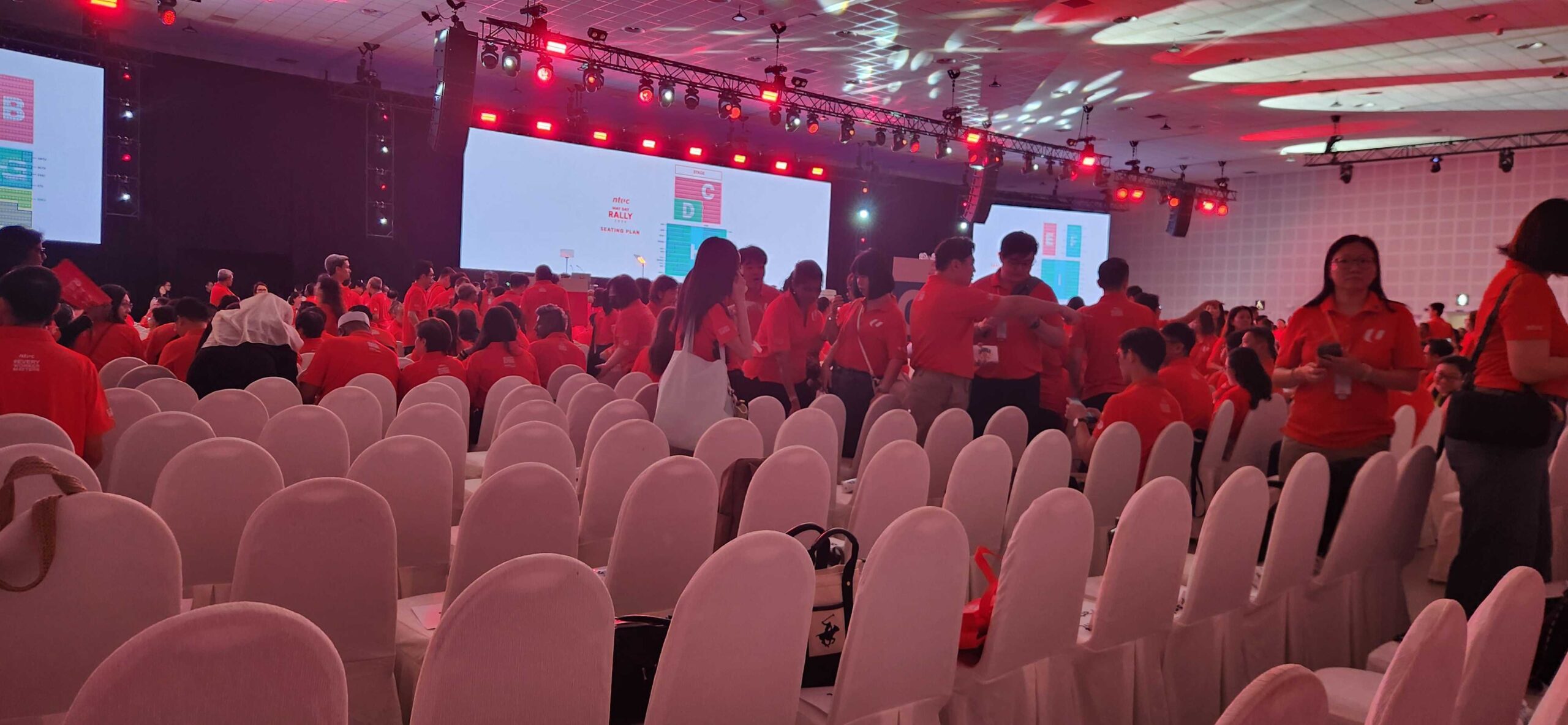
We were at the rally and let’s just say that this is likely the first time we’ve heard the word “AI” repeated so many times in just a few hours.
But before that, you need to know something: the new Tripartite Jobs Council (TJC), initiated by NTUC specifically to address AI’s impact on workers, jobs, and businesses.
The idea is to bring all three tripartite partners under one coordinated roof to do three things: support businesses with workforce transformation as they adopt AI, fund broad-based and sectoral training (with targeted help for at-risk worker segments and occupations), and build public awareness so workers actually take up the support that’s available.
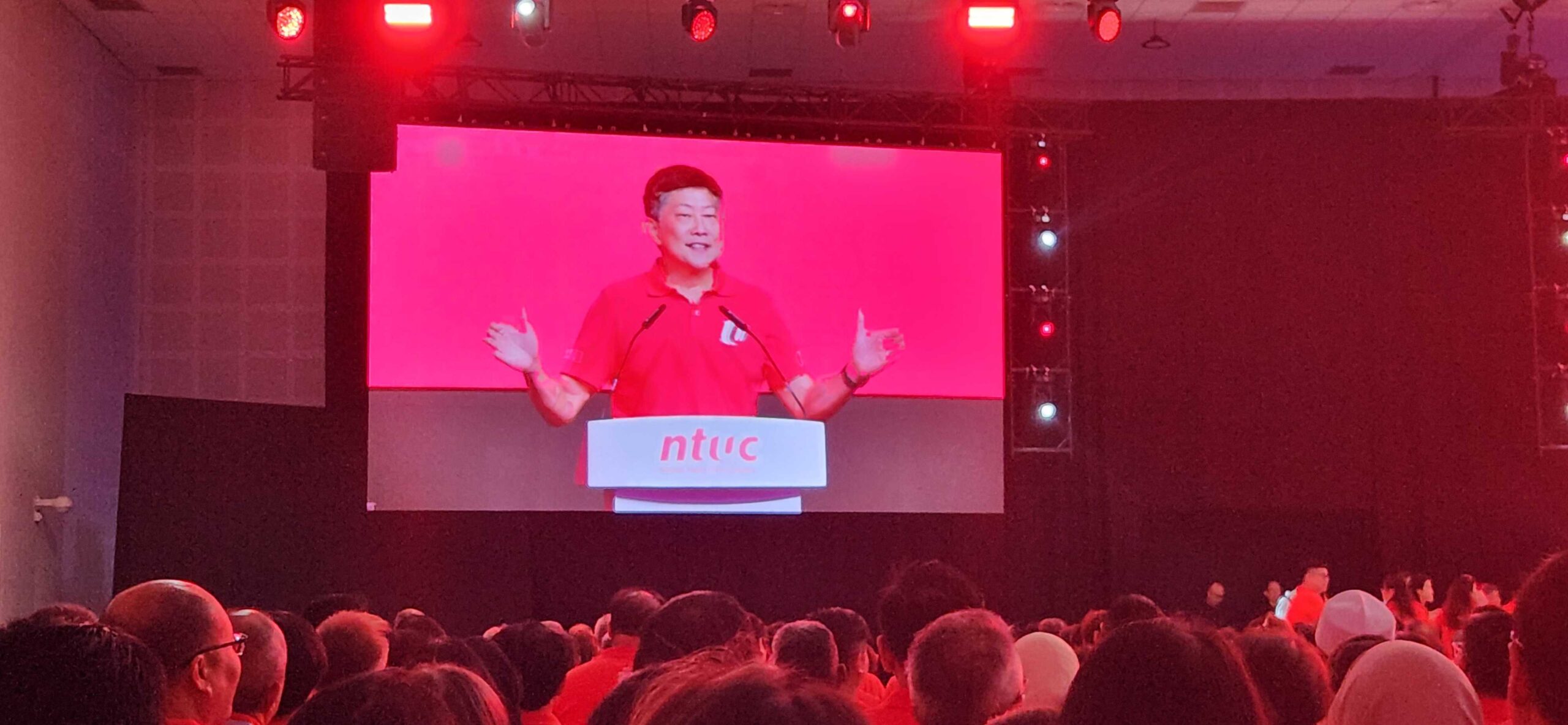
NTUC Secretary-General Mr Ng Chee Meng positioned the TJC as the Labour Movement’s response to AI disruption: with particular focus on PMEs and younger workers, who are most likely to feel the impact.
For NTUC members, the most concrete takeaway from the rally is this: from 1 May 2026 to 30 April 2028, UTAP can now be used not just for AI training courses, but to subscribe to selected AI tools as well.
The list will be reviewed regularly and covers tools that support content creation, writing, software development, and digital marketing: basically, the day-to-day stuff a lot of PMEs are already trying to figure out.
It’s a small but practical move: instead of paying out of pocket to learn AI on your own, your union benefit can now help cover the cost of actually using it at work.
When PM Wong gave his speech, he didn’t sugarcoat the AI situation. He openly acknowledged that some jobs will change, some will disappear, and the pace of change will be faster than anything we’ve seen before.
But his core message was that while not every individual job can be saved, every worker can be, and the Government’s commitment is to support every Singaporean through the transition, not just protect outdated roles.
He also urged Singaporeans not to let anxiety hold them back, calling on them to embrace AI rather than resist it.
On the Middle East front, he reaffirmed that the Government will continue to act decisively if the energy crisis worsens, and pointed to NTUC FairPrice’s price freeze on essential items as an example of how businesses can step up alongside policy.
Why This All Matters
It’s easy to take Singapore’s relatively stable employment landscape for granted. But the reason your boss can’t just fire you on a whim, the reason there are guidelines around flexible work arrangements, or the reason there’s a safety net when economic crises hit, exists because of decades of quiet work between unions, employers, and the Government.
So this May Day, when you’re enjoying the public holiday, maybe spare a thought for the system working quietly in the background, and the labour movement that keeps showing up for workers, year after year.
Because at the end of the day, #EveryWorkerMatters, and that’s not just a hashtag.
This article is written in collaboration with NTUC.

